
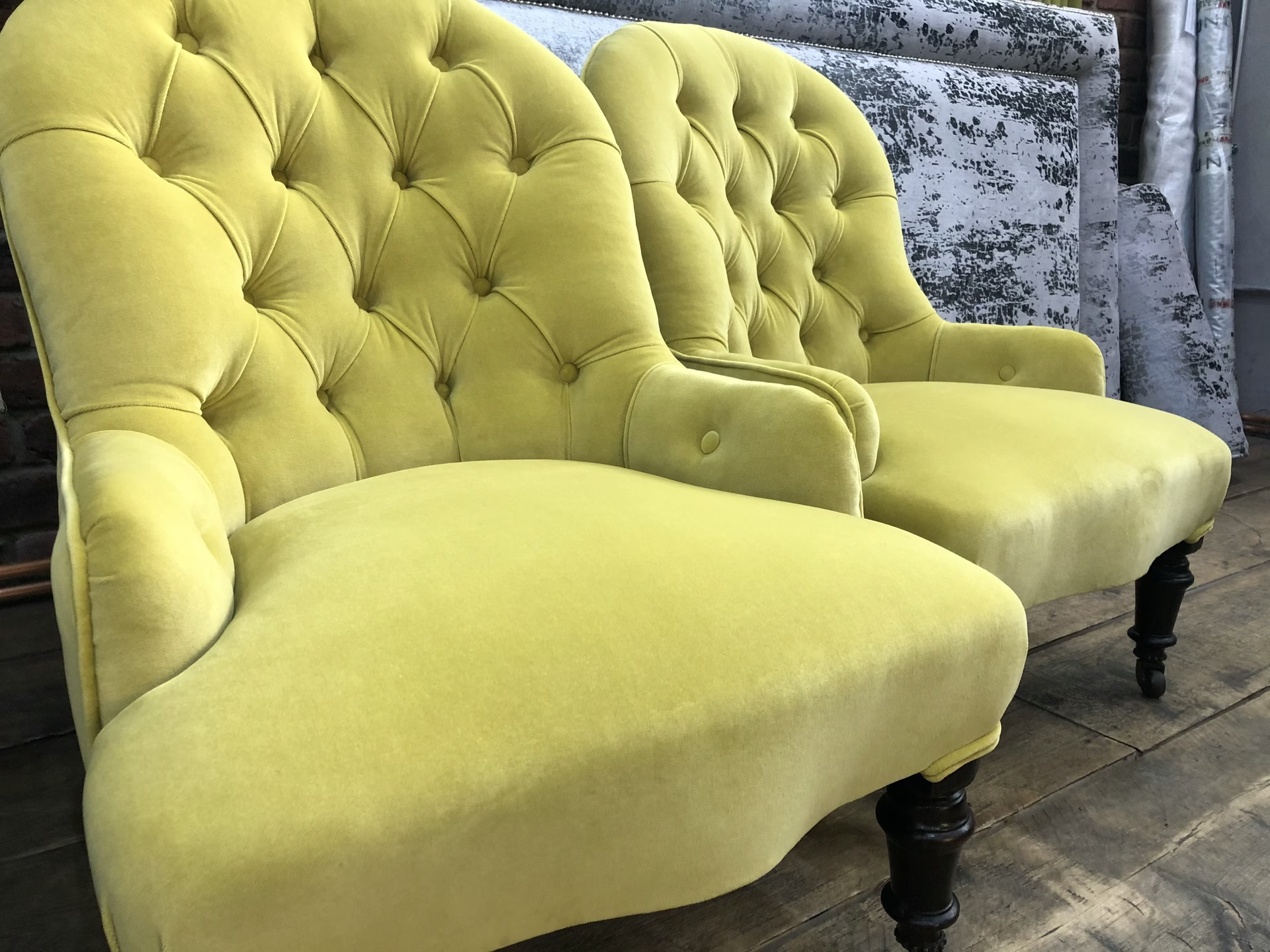
Choosing fabric for dining chairs.
Wipe-clean finishes, smart pattern choices across a matching set, and what to check underneath the seat pad.
Dining chairs face red wine, coffee, cooking oils and constant sliding across floors, yet people spend less time sitting on them continuously than on a lounge sofa.
That shifts what matters: cleanability, tight yarns that do not absorb grease, and sensible pattern scale across six, eight or twelve chairs count more than an extreme contract rub rating alone.
Cleanability comes first
Choose stain-resistant velvets, wipeable faux leathers, waxed leathers or tightly woven wool blends. Natural lanolin in wool sheds light splashes naturally, while modern coated velvets let water lift everyday spills.
Drop-in seats versus full backs
Antique and timber-frame chairs with removable drop-in pads are economical on cloth (roughly 0.7 to 1.0 metre per pair in a plain). Sprung or fully upholstered high-back chairs usually take 2.0 to 2.5 metres each.
Matching a set cleanly
Stripes, plaids and large florals have to sit at the same height on every chair around the table. Small textured weaves and subtle herringbone plains keep cutting waste down across eight or ten chairs.
Seat foam and frame joints
Re-covering is the right moment to reglue loose dowels, tighten corner blocks and replace collapsed seat foam with firmer high-resilience cushions that hold their edge.
Easy-clean and hard-wearing options.
Filter our library by stain-resistant finishes, washability, faux leather and wool weaves before booking a showroom look.
What comes up most in the showroom.
Stain-resistant velvets, washable tight-weave plains, wool blends and quality faux leathers wipe clean far better than raw cotton or untreated linen. Look for supplier-tested easy-clean finishes if the chairs are used daily.
Drop-in seats usually need roughly 0.7 to 1.0 metre per pair of seats in a plain cloth, so six drop-in seats take around 2.5 to 3 metres. Fully upholstered high-back dining chairs take roughly 2.0 to 2.5 metres per chair, plus allowance for matching stripes or checks.
Small all-over geometrics, herringbone weaves and textured plains hide everyday marks better than flat pale solids. Large motifs work well on the outer back of a carver chair paired with a plain seat.
Yes. Dining chair seats flatten quickly on thin foam. When we re-cover a set in Heybridge we check webbing, joints and seat pads so every chair sits evenly again.
Choosing cloth for other pieces.
Best fabric for a sofa
Rub counts, claws, pile weaves and UK fire rules for daily family sofas.
Best fabric for a headboard
Deep buttoning, vertical fluting, bedroom prints and pairing cloth with wall paint.
Best fabric for roman blinds
Medium weights that pleat square, blackout linings and kitchen or bay windows.
Serving Essex and Suffolk from our Heybridge workshop.
We handle dining chair reupholstery and seat pads from our workshop in Heybridge, Maldon, covering homes and commercial premises across Essex, Suffolk and Greater London for larger projects.
Re-covering a dining set?
Send a photo of one chair and tell us how many are in the set. We will advise on cloth and metreage.
Questions, answered.
Stain-resistant velvets, washable tight-weave plains, wool blends and quality faux leathers wipe clean far better than raw cotton or untreated linen. Look for supplier-tested easy-clean finishes if the chairs are used daily.
Drop-in seats usually need roughly 0.7 to 1.0 metre per pair of seats in a plain cloth, so six drop-in seats take around 2.5 to 3 metres. Fully upholstered high-back dining chairs take roughly 2.0 to 2.5 metres per chair, plus allowance for matching stripes or checks.
Small all-over geometrics, herringbone weaves and textured plains hide everyday marks better than flat pale solids. Large motifs work well on the outer back of a carver chair paired with a plain seat.
Yes. Dining chair seats flatten quickly on thin foam. When we re-cover a set in Heybridge we check webbing, joints and seat pads so every chair sits evenly again.